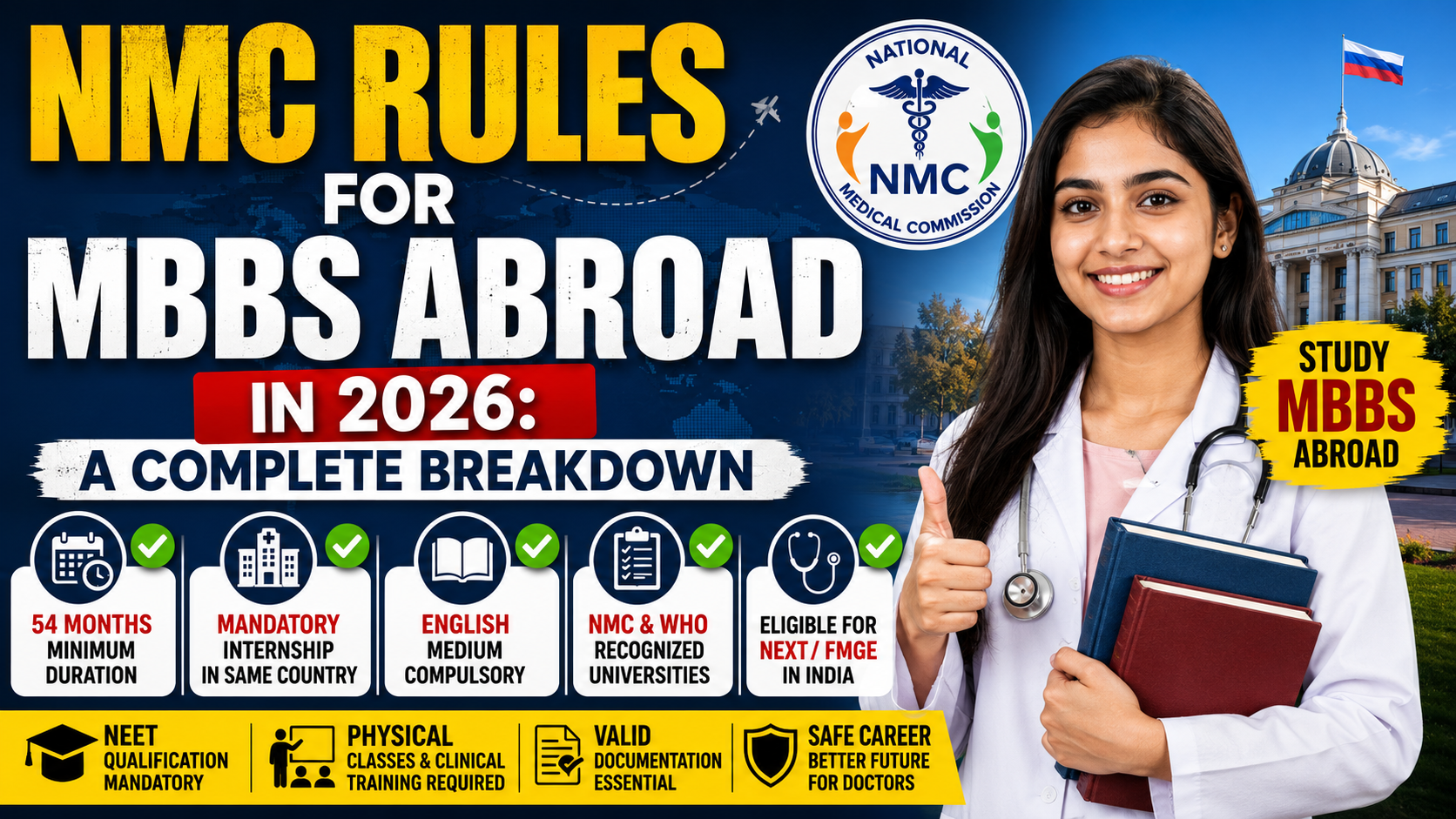
NMC Rules for MBBS Abroad in 2026: A Complete Breakdown
Studying MBBS abroad continues to be a popular choice among Indian students due to affordable tuition fees, global exposure, and access to internationally recognized universities. Countries like Russia, Georgia, Kazakhstan, Uzbekistan, and others attract thousands of Indian medical aspirants every year.
However, before taking admission abroad in 2026, students must clearly understand the latest National Medical Commission (NMC) rules. These regulations directly affect a student’s eligibility to practice medicine in India after completing their degree.
Choosing a university without checking NMC guidelines can create serious problems later, including disqualification from licensing exams or internship issues in India. Therefore, students and parents should carefully verify all regulations before applying.
Why NMC Rules Are Important
The National Medical Commission is the official authority regulating medical education and medical practice in India. Any Indian student studying MBBS abroad must follow NMC guidelines to become eligible for registration and practice in India.
After completing MBBS abroad, students must appear for licensing procedures such as:
- FMGE (Foreign Medical Graduate Examination) or
- NExT (National Exit Test), whenever implemented officially.
If the foreign medical degree does not meet NMC standards, the student may face difficulties obtaining registration in India.
Important NMC Rules for MBBS Abroad in 2026
1. Minimum Course Duration Must Be 54 Months
According to NMC regulations, the MBBS course abroad must have:
- A minimum duration of 54 months (4.5 years)
- Followed by a mandatory internship/clinical training
Short-duration medical programs are not accepted.
Students should avoid universities offering “fast-track” medical degrees.
2. Mandatory Internship Requirement
The internship is one of the most important NMC requirements.
The foreign medical university must provide:
- A compulsory internship
- Conducted in the same country where the student studies
- Under proper medical supervision
Internships completed online or in another country may not be accepted.
Students must verify:
- Internship duration
- Clinical exposure
- Hospital affiliations
- Patient interaction opportunities
3. Entire Course Must Be Taught in English
NMC requires that the complete MBBS program must be taught in English medium.
Students should confirm:
- Lecture language
- Clinical training language
- Study materials and exams
Some universities initially promise English-medium education but later shift partially to local languages during clinical years. This can create problems during licensing verification.
4. Students Must Study All Major Subjects
The curriculum should include all core medical subjects similar to Indian MBBS standards, such as:
- Anatomy
- Physiology
- Biochemistry
- Pathology
- Pharmacology
- Surgery
- Medicine
- Pediatrics
- Obstetrics & Gynecology
- Psychiatry
- Community Medicine
Incomplete or reduced curricula may affect eligibility in India.
5. NEET Qualification Is Mandatory
Indian students planning to study MBBS abroad must qualify NEET.
Without NEET qualification:
- Students may still get admission abroad in some countries
- But they may not be eligible to practice in India later
NEET qualification is currently compulsory for Indian students pursuing foreign medical education.
6. University Must Be Recognized
Before admission, students should check whether the university is:
- Recognized by the NMC
- Listed with WHO
- Approved by the country’s medical authority
Recognition ensures the degree has international validity.
7. Clinical Training Must Be Physical & Offline
NMC strictly requires:
- Physical classroom teaching
- Hands-on practical training
- Direct patient interaction
Online-only or hybrid medical programs are not accepted for Indian licensing purposes.
8. No Transfer Between Universities
Frequent university transfers can create documentation and eligibility complications.
Students should:
- Choose the right university carefully from the beginning
- Avoid unnecessary transfers during MBBS
9. Students Must Maintain Proper Documentation
Students should safely maintain:
- Admission letters
- Visa copies
- Academic transcripts
- Attendance records
- Internship completion certificates
- Passport copies
- Degree certificates
These documents are essential during NMC verification in India.
Common Mistakes Students Should Avoid
Many students face issues because they:
- Choose universities without checking NMC compliance
- Focus only on low fees
- Ignore internship structure
- Believe fake promises
- Delay documentation
- Do not verify medium of instruction
Proper guidance and research are extremely important.
Best Way to Choose an MBBS University Abroad
Before finalizing a university, students should verify:
- NMC eligibility compliance
- University reputation
- Clinical exposure quality
- Safety and student support
- Indian student reviews
- Hostel and food facilities
- Local support availability
Experienced educational consultants can help students avoid mistakes and choose universities that meet current regulations.
Final Thoughts
Pursuing MBBS abroad in 2026 can be an excellent opportunity for Indian students if planned correctly. Understanding NMC rules is not optional—it is essential for securing a valid medical career in India.
Students should never take admission based only on advertisements or low fees. Instead, they should focus on choosing universities that fully comply with NMC regulations and provide proper education, internship training, and long-term career support.
With the right planning, verified universities, and proper guidance, students can confidently achieve their dream of becoming successful doctors through MBBS abroad programs.